
Japanese Yen & Co: What Prospects for 2026?
At the turn of each year, a plethora of financial studies are published with the aim of identifying the most promising assets for the upcoming period. However, it is rare for these studies to devote a thorough and targeted analysis to currencies as a standalone investment class, despite their often-decisive impact on investors’ returns.
The Role of the US Dollar for Euro Investors
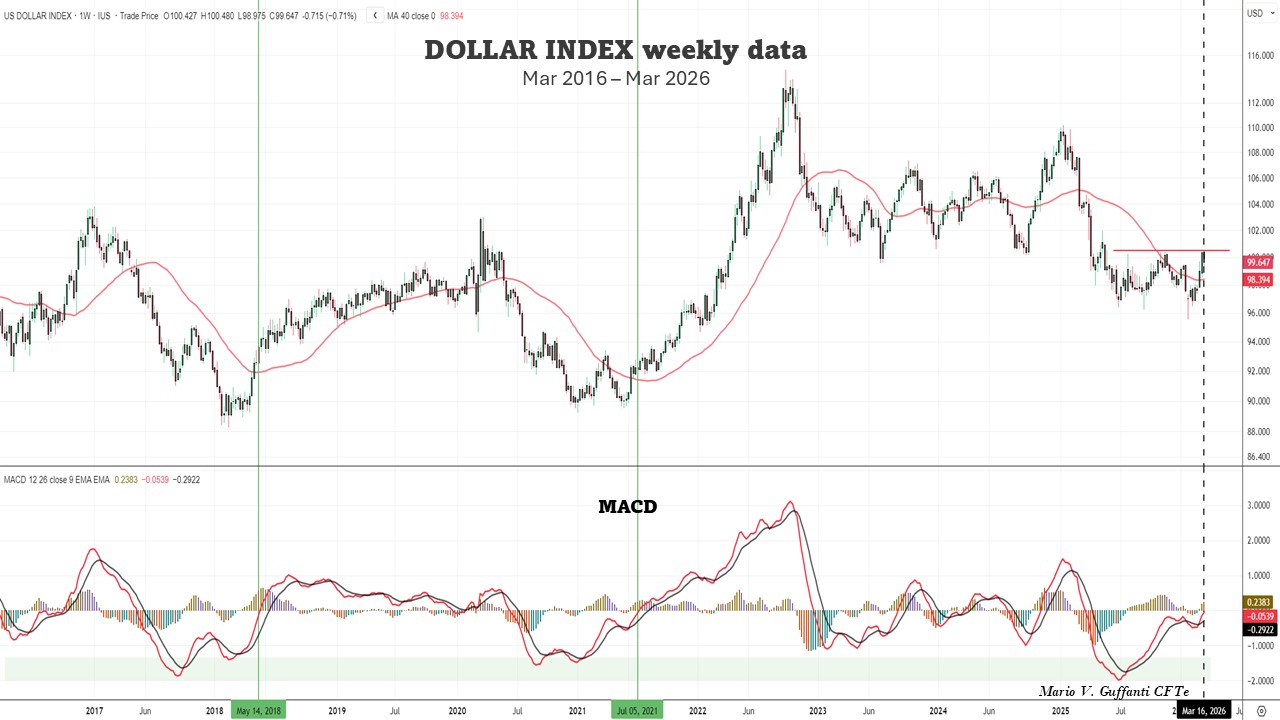
In fact, last year, one of the most important factors was the performance of the US dollar, which acted as a strong detractor for those investing in euros. This has led to continued pessimism regarding the American currency at the start of this year among investment professionals.
The market, however, remains unpredictable. Examining a ten-year Dollar Index chart reveals a potential comeback for the US dollar: the price is once again challenging resistance around the 100 mark, having crossed the 200-day moving average, which is beginning to flatten. The MACD oscillator is close to the zero line, and historically, reversals from low levels (green area on the chart) have led to robust trends. Naturally, it would be simplistic to assume that these signals guarantee results, but technical analysis is probabilistic rather than predictive. It merely suggests which direction to watch, and the prices will confirm if it unfolds.
Commodity Exporter Currencies: Norwegian Krone and Australian Dollar
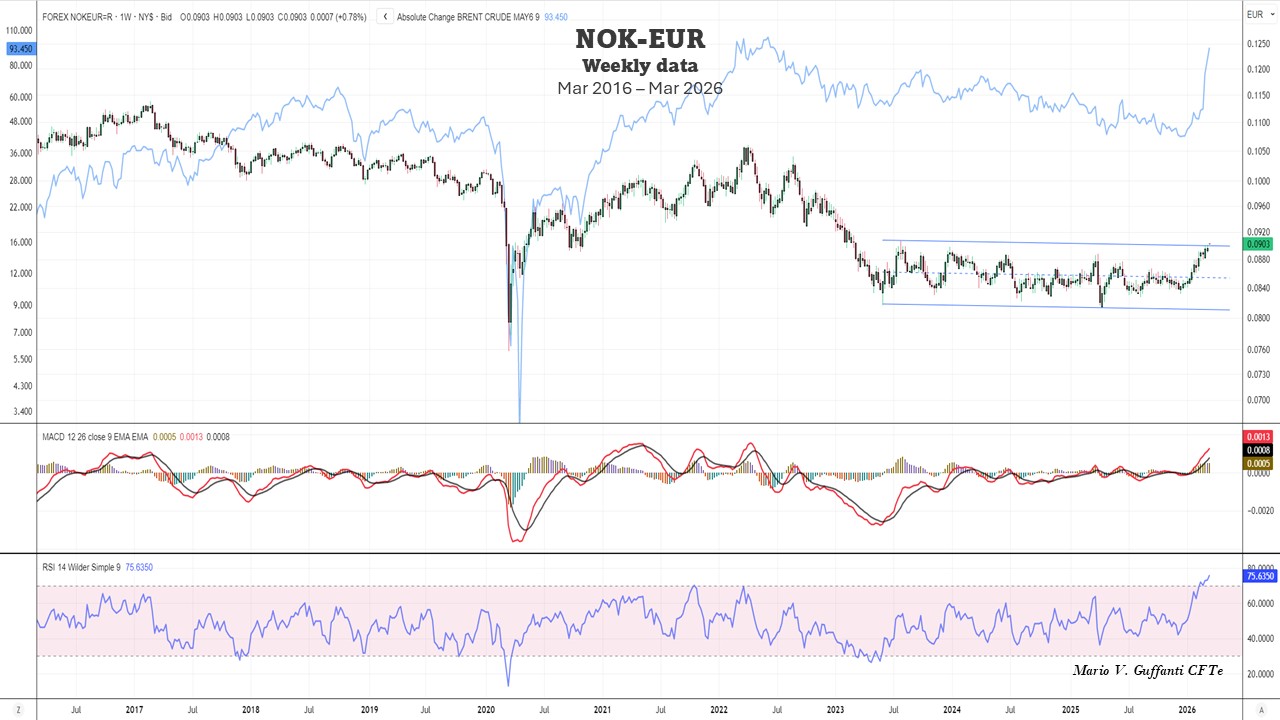
For those thinking in euros, currencies of commodity-exporting countries such as the Norwegian krone (NOK) and Australian dollar (AUD) warrant attention. These have delivered strong performances, but their future reliability is closely tied also to oil price movements, introducing considerable uncertainty. A ten-year NOK/EUR chart shows that price rises within the channel, and an overbought RSI are strongly correlated with oil price spikes (represented by a blue line on the chart—prices on the left scale).
Swiss Franc: A Stable Option for Euro Portfolios
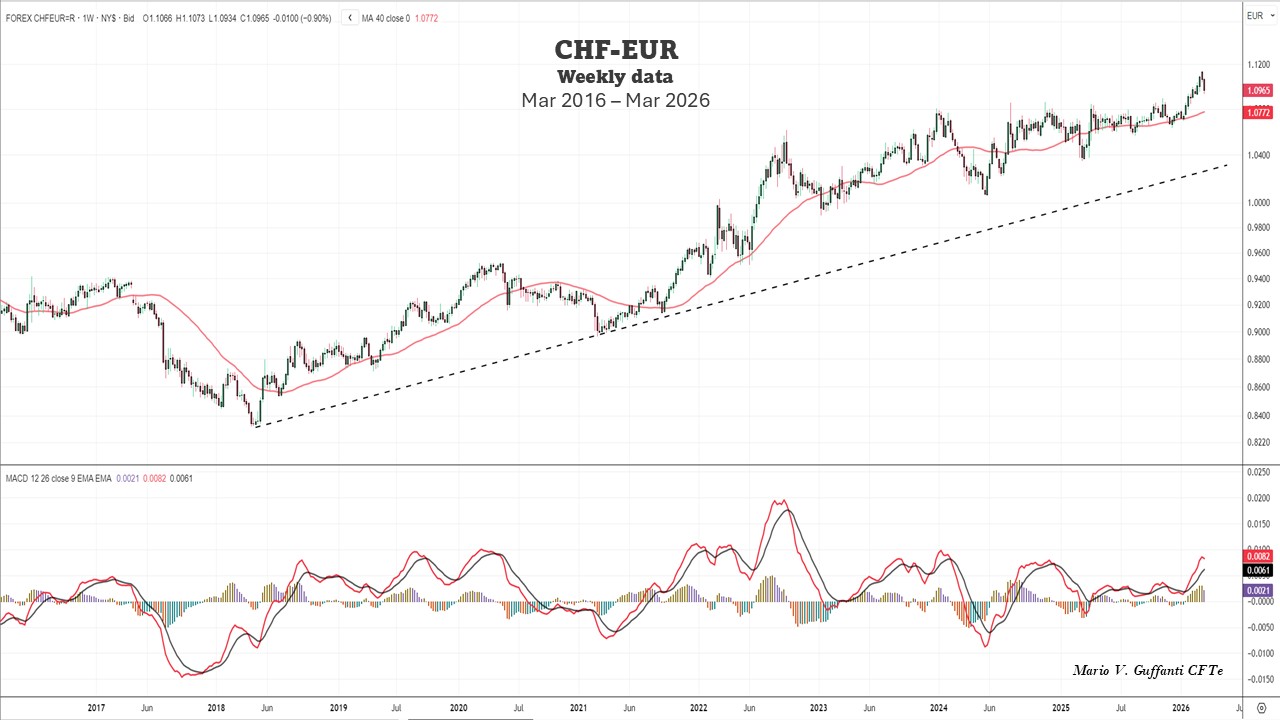
An interesting strategy for euro-based portfolios involves allocating a small portion of liquidity to the Swiss franc. A decade-long CHFEUR analysis highlights a clear upward trend, with the currency pair nearing the 200-day moving average. A European investor holding Swiss francs for the past 37 years would have nearly doubled their capital.
Japanese Yen: Unique Dynamics and Long-Term Performance
Among potentially interesting currencies like the Swiss franc, the Japanese yen stands out for its unique characteristics. A long-term performance chart compares returns for a European investor in Swiss francs, US dollars, Norwegian krone, Australian dollars, and Japanese yen.
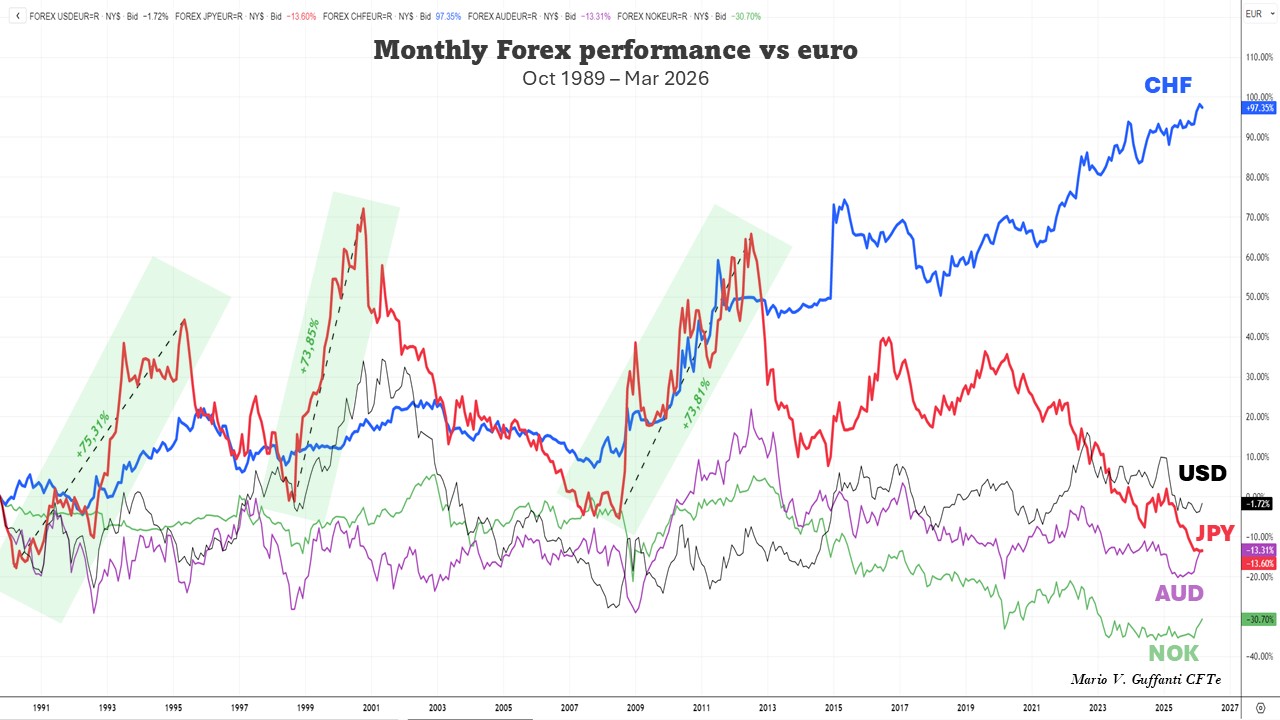
The most striking feature is the Swiss franc’s persistence against the euro. Equally notable is the wide scope of the Japanese yen’s trends. Historically, the yen has shown significant trend swings versus the euro, with moves exceeding 70%. The first major trend in the early 1990s was due to the bursting of the Japanese speculative bubble; the second coincided with the euro crisis, and the third with the 2008 financial crisis, when the yen acted as a safe haven. Such reversals are particularly evident when the yen curve starts from a very low point.
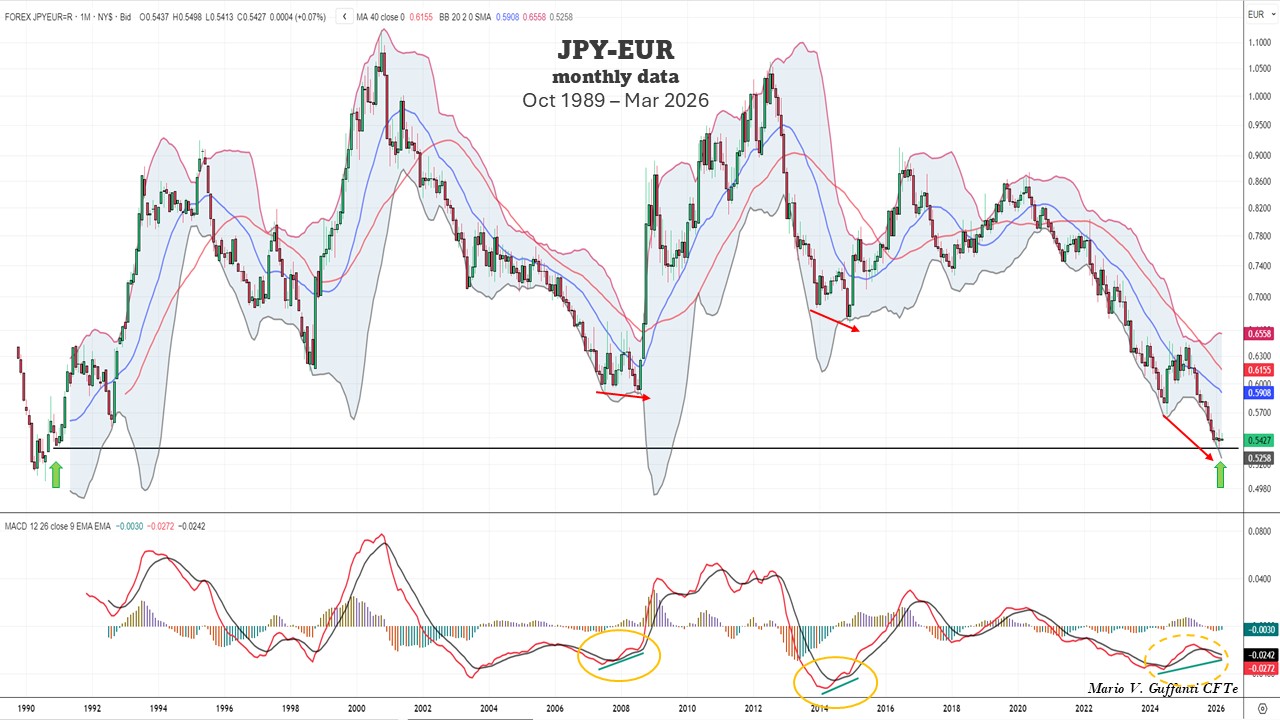
Current Position and Technical Indicators for the Japanese Yen
Today, the monthly JPYEUR chart, with data starting from 1989, shows the curve has returned to levels seen at the end of 1990, a potentially favourable zone. Furthermore, the oscillator displays a divergence similar to those observed in 2008 and 2014, though the definitive signal is still missing: the MACD (red line) needs to cross the Signal Line (black line) upwards for the pair to gain momentum. Thus, a period of consolidation and strength is still required.
Japan’s Economic Transformation and Yen Outlook
Charts always provide a synthesis reflecting underlying reality: the Japanese economy is currently undergoing profound changes, thanks to the end of its long deflationary period and the normalization of monetary policy by the Bank of Japan. In such a rapidly evolving macroeconomic context, it may be time to pay closer attention to the Japanese currency.
About the author

Mario Valentino Guffanti is a board member and Head of the Lugano Chapter. He is a financial advisor, technical analyst and researcher based in Milan, Italy. As an author of technical articles and lecturer as well as instructor in technical analysis courses in Switzerland, he is also dedicated to financial coaching through NLP techniques (neuro-linguistic programming).
Disclaimer: All methods, techniques, charts, analysis or results presented in this SAMT Blog are for educational purposes only. The information provided should not be construed in any way as a recommendation to buy or sell any financial instrument. You should always consult with your licensed financial advisor and tax advisor to determine the suitability of any investment to your particular financial situation. The author does not have a position in mentioned securities at the time of publication. Any opinions expressed herein are solely those of the author, and do not in any way represent the views or opinions of any other person or entity. SAMT and its affiliates, directors or agents will not be held liable or responsible for your investment decisions.
SAMT nor any of its affiliates, directors or agents are a financial advisory service, nor a licensed financial advisor and do not provide financial advice whatsoever in any financial product.
Further it should not be assumed that any methods, techniques or indicators presented will be profitable or that they will not result in losses. Past results of any individual trader or trading system presented are not indicative of future returns by that trader or system, and are not indicative of future returns which may or may not be realized by you.
Pictures uploaded and used in this article may be subject to copyright. The author itself is solely responsible for adhering to any applicable copyright laws.
By viewing the material on this page, you fully agree that you understand and consent to the above disclaimer.
 Women in TA Workshop
 IFTA 2026 conference in London, UK – SPECIAL PROMO
 S&P500 – Expected Green Path v. Red Path until the end of 2026